
In this article
Incense at a tea gathering can express a choice about the setting: beyond what to drink, there is the question of whom to spend time with, and where. Wen Zhengming’s Living Aloft brings tea and incense into just such an imagined life.[1] Beginning with the friends and the burner in the painting, we can understand this taste without treating incense as a required step in drinking Chinese tea.
Begin with the people in the painting
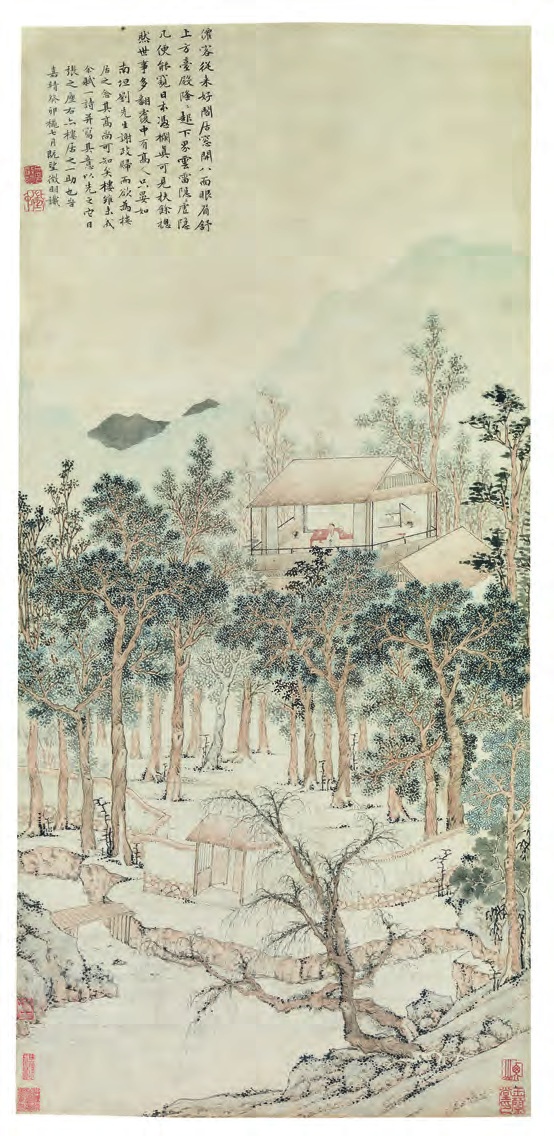
In 1543, Wen Zhengming painted Living Aloft for his friend Liu Lin. Trees surround a pavilion, where two friends meet upstairs. The Metropolitan Museum of Art’s catalogue describes them conversing by the window with tea in hand, while incense rises from a bronze censer behind them.[1][2]
One detail makes this more interesting than a record of people enjoying tea and incense: the house had not yet been built. Wen was imagining a life for a friend who had retired from government service.[1][2]
The painting shows what one Ming artist chose to include in an ideal gathering. Tea, friends, a pavilion sheltered by trees, and incense all have a place. The cultural connection becomes easier to grasp when it has people and a setting.
Incense belongs to the whole gathering
Asking which incense goes with a particular tea focuses attention on two materials. The painting offers a wider relationship: tea close at hand, a burner behind the friends, and conversation between them. Our reading is that incense contributes to how the place feels and how people spend time together there.
In the life imagined here, the tea in the cup and the surrounding room both receive attention. That is a more useful way into the scene than searching it for a historical pairing formula.
Later, the late Ming writer Wen Zhenheng brought incense and tea together in a section of Changwu zhi, his book on cultivated living. Its opening mentions conversation, reciting verse, and reading by lamplight.[3] Painting and writing offer two ways into the subject: one pictures a gathering; the other treats tea and incense as interests worth considering closely.
Leave room for the tea’s own fragrance
Appreciating incense at a tea gathering does not require every fragrance to be present at once.
Writing much earlier, in the Northern Song period, Cai Xiang stated in Cha lu that tea has its own true fragrance. He recorded that a little longnao, an aromatic material, was added to tribute tea, while people tasting tea in Jian’an left aromatics out for fear of obscuring its character.[4] His subject was fragrance added to tea, rather than incense burned in the room. Yet the passage preserves a clear preference: tea deserves to be appreciated on its own terms.
For a gathering today, our suggestion is to begin with its purpose. If you want to distinguish the nuances of a tea, you can enjoy incense at another time. If the occasion is more about spending time with friends, decide together whether incense belongs. Neither choice needs a fixed table matching green tea, oolong, or black tea to a particular fragrance.
A tea gathering can make its own choices
Living Aloft does not tell us what aromatic material was in the burner, or offer proportions for a pairing. What it gives us is worth remembering: when an artist imagined a future home for his friend, tea, conversation, and incense appeared together.
That provides an approachable starting point for a tea setting today. Incense can be part of the pleasure of hosting and inhabiting a room; whether and when to use it depends on the gathering. Cultural meaning grows through the choices people make with these things.
Continue with incense in the Chinese scholar’s study for a closer look at vessels and their arrangement. Before burning incense at home, read our practical home-use guide.
Sources & notes
Museum records and historical texts behind this article. We checked the museum catalogue’s original page; historical text passages were read in electronic transcription. English renderings of Chinese passages are ours.
- Living Aloft: Master Liu's Retreat, p. 28The Metropolitan Museum of Art
Recent Acquisitions: A Selection, 2016–2018, Bulletin 76(2), printed p. 28 (PDF p. 30), signed JS-D. The original page was checked for tea, conversation, the bronze censer, and the house not yet built. The scene is an imagined ideal, not a documented gathering. PDF: https://cdn.sanity.io/files/cctd4ker/production/cda6debf0600697c4d79c87ec2941c199d360ef7.pdf#page=30
- Living Aloft, 1543, accession 2017.327.2The Metropolitan Museum of Art
Supports Wen Zhengming’s authorship, the date, Liu Lin, and the imagined retirement home. The painter Wen Zhengming and the writer Wen Zhenheng are different people. The museum identifies the image as Public Domain.
- Changwu zhi, volume 12: incense and teaWen Zhenheng / Wikisource
Opening passage, electronic transcription of the Siku Quanshu edition. Incense and tea share a section and several social and solitary settings. This does not establish a universal pairing procedure or identify all historical incense as modern sticks.
- Cha lu: the passage on fragranceCai Xiang / Wikisource; National Palace Museum
The passage concerns aromatics added to tea, not a ban on room incense. Compared with the museum’s transcription of a Qing copy by Ni Chengkuan: https://digitalarchive.npm.gov.tw/Collection/Detail/25675?dep=P . The copy is not Cai Xiang’s autograph.
Quiet Xiang Editorial completed an internal source review of museum records and historical texts. The connection to a gathering’s atmosphere is our editorial reading. We have not conducted tea-and-incense pairing tests, interviews, or external expert review. Our editorial approach.