
In this article
In the home described by Wen Zhenheng, a writer of the late Ming period, the study held more than reading and writing. There was tea to drink, objects to appreciate, and fragrance to notice. Incense belonged to this attention to everyday surroundings: its scent entered the room, while its burners and boxes became objects to use and admire.[1][4]
“There should not be two incense burners in the study,” Wen wrote in Changwu zhi.[1] Even the number mattered to him. Following such details, we begin to see how incense could connect a room with its owner’s taste.
A room for reading, writing, and looking
Wen lived in Suzhou, China, from the late sixteenth to the mid-seventeenth century. His Changwu zhi discusses rooms, plants, paintings, furniture, incense, and tea, setting out his detailed ideas about how to furnish and inhabit a home.[2]
The entry on a “small room,” in the section on arrangement, gives us a place to begin: a writing desk with a narrow edge, furnished with brushes, an inkstone, an incense box, and a burner. A separate small stone table holds tea utensils. Wen wanted the objects on the desk to be “small and elegant.”[1]
For a reader today, this is a private room that brings together reading, writing, and the pleasure of collecting. Paintings and calligraphy invite the eye; objects offer useful and pleasing forms; incense adds scent. Together, they suggest a familiar question: what kind of surroundings do I want to spend time in?
One burner, carefully placed
In his entry on placing a burner, Wen lists a single burner, incense boxes of different sizes, and a small vessel for incense tools. The boxes hold different aromatics, including agarwood and incense cakes. He objects to having two burners in the study, placing one on a table beneath a hanging painting, or arranging the vessel and boxes in facing pairs.[1]
His attention extends to the whole arrangement. Which container holds the incense? Where do the tools go? How do these objects sit alongside a painting? Using fragrance involves choices about storage and display as well as the burner itself.
The same passage offers another memorable preference: ceramic burners in summer, copper-alloy burners in winter. Wen gives no reason for the choice, but he clearly connects the vessel with the season.[1] A familiar room could change a little as the year turned.
These prescriptions reveal Wen’s particular eye. Number, material, and placement all express a choice. They give us a more revealing picture than the simple observation that people in the past enjoyed incense.
A landscape carved into bamboo
A surviving object offers another way into this world of taste.
The Metropolitan Museum of Art holds a bamboo incense holder catalogued under Zhu Sansong and dated to the late sixteenth or early seventeenth century. Its surface is carved with scholars among a wooded landscape.[3]
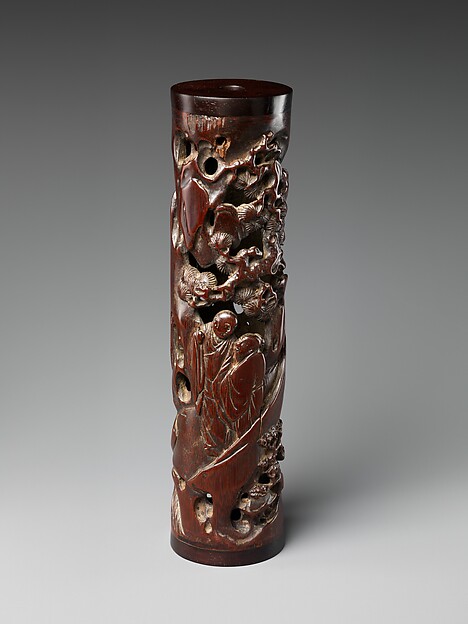
The openwork has two roles: it forms the landscape and allows fragrance from incense sticks burning inside to escape.[3] Function and craftsmanship meet in the same surface. The bamboo is both a container and a scene that rewards close looking.
Reading among the pleasures of incense and tea
The opening of Changwu zhi’s section on incense and tea mentions practising calligraphy by copying models, reciting verse, reading by lamplight, conversation, and walks after a meal. Wen brings incense and tea into several kinds of everyday activity.[4]
Reading has a place among them, without becoming a prescribed sequence of steps for a special reading ritual. This offers an approachable way to understand the tradition: incense could accompany time alone or time with others, taking on meaning through the occasion.
Nor did all of this incense take the same form. The passage on burner placement lists incense cakes; the incense and tea section discusses heating aromatic material indirectly, rather than placing it directly in the fire. The museum’s bamboo holder record specifically describes incense sticks.[1][3][4] Keeping these forms distinct helps us understand how a stick used today relates to a broader history of scent.
What a burner tells us about a room
Read together, these texts and objects give incense a tangible place in the study. It accompanies reading, writing, and tea, while bringing the storage of aromatics, the arrangement of vessels, and the appreciation of carving into everyday life. This is one way we can understand this part of the incense tradition.
Wen’s seasonal preference is particularly telling: a ceramic burner for summer, a copper-alloy one for winter.[1] Even this small object on the desk called for a fresh choice as the seasons changed. Through that detail, we glimpse how one late Ming writer thought about living in a room—and the place incense held within it.
If you burn incense while reading today, use a stable, heat-resistant holder that catches ash, keep it away from books, paper, and textiles, ventilate the room, and remain nearby throughout. Historical desk arrangements are not instructions for safe use today. See our guide to burning incense safely at home for practical guidance.[5][6]
Sources & notes
Historical texts and museum records behind this article. English quotations are Quiet Xiang translations. The historical texts were compared in electronic transcription; scanned originals were not independently collated.
- Changwu zhi: arrangement, burner placement and the small roomWen Zhenheng / Shidian Guji
Wen Zhenheng, Changwu zhi, section on arrangement, entries on burner placement and the small room. We compared the Shidian Guji electronic text (https://www.shidianguji.com/zh/book/CADAL02020208/chapter/1ljxzt6fzol5m) with the Wikisource transcription of the Siku Quanshu edition (https://zh.wikisource.org/wiki/長物志_(四庫全書本)/卷08). Their volume numbering differs, so we identify passages by section and entry. English quotations are our translations; “copper-alloy” renders tong without asserting a specific alloy composition. These passages record Wen’s preferences, not the arrangements of every household of his time.
- Wen ZhenhengPalace Museum
The Palace Museum: entries on Changwu zhi (https://www.dpm.org.cn/lemmas/240057.html) and Wen Zhenheng (https://www.dpm.org.cn/lemmas/240056.html). Sources for the author’s identity, period, location, and the scope of the book.
- Incense holder with scholars in a landscapeThe Metropolitan Museum of Art
The Metropolitan Museum of Art: Incense holder with scholars in a landscape (https://www.metmuseum.org/art/collection/search/39626), accession 1995.271. Source for the attribution, bamboo material, date, subject, and the function of the openwork. The record does not establish the holder’s original room or a particular historical owner.
- Changwu zhi: incense and teaWen Zhenheng / Wikisource
Wen Zhenheng, Changwu zhi, section on incense and tea (https://zh.wikisource.org/wiki/長物志_(四庫全書本)/卷12), opening passage and entry on agarwood. The opening discusses incense and tea together. Historical claims about their effects are not treated as evidence of benefits from modern incense products.
- Sources of Indoor Particulate MatterUS EPA
US Environmental Protection Agency: Sources of Indoor Particulate Matter (https://www.epa.gov/indoor-air-quality-iaq/sources-indoor-particulate-matter-pm); London Fire Brigade: Candles (https://www.london-fire.gov.uk/safety/the-home/candles/). Sources for ventilation and indoor combustion context, and for supervision, heat-resistant supports, and separation from combustible materials, including guidance covering incense.
- Candles and incense fire safetyLondon Fire Brigade
US Environmental Protection Agency: Sources of Indoor Particulate Matter (https://www.epa.gov/indoor-air-quality-iaq/sources-indoor-particulate-matter-pm); London Fire Brigade: Candles (https://www.london-fire.gov.uk/safety/the-home/candles/). Sources for ventilation and indoor combustion context, and for supervision, heat-resistant supports, and separation from combustible materials, including guidance covering incense.
Quiet Xiang Editorial researched historical texts and museum records and developed the interpretations in this article. This was an internal source review. This work did not include testing historical objects, field interviews, or external expert review. Our editorial approach.